



Tony Robbins – Leadership Academy Review: Is It Worth Your Investment?
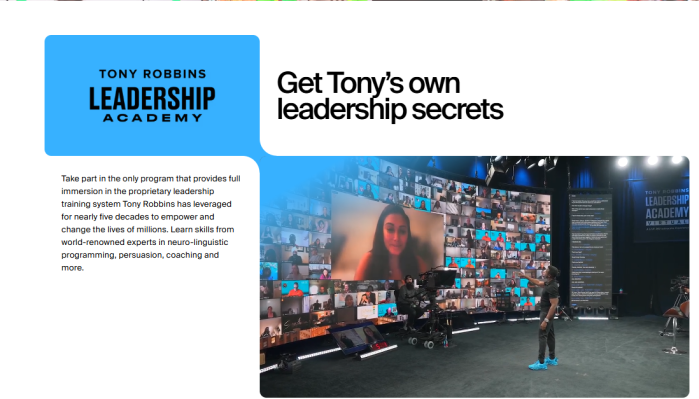
Effective leadership is rarely an inherent trait; it is a discipline built through deliberate practice, emotional intelligence, and strategic clarity. Among the extensive array of executive development programs available today, Tony Robbins – Leadership Academy stands out as one of the most high-energy, experiential immersion courses designed for entrepreneurs, executives, and aspiring leaders.
Whether you are looking to scale an organization, align a high-performing team, or master your personal influence, this comprehensive review dives deep into what the program delivers, how the methodology works, and whether it justifies your time and investment.
Executive Summary: What Is Leadership Academy?
Leadership Academy is a multi-day immersive training system created by renowned peak-performance strategist Tony Robbins. Unlike standard academic management courses that focus strictly on theory, organizational structures, and administrative mechanics, this program focuses heavily on human psychology, behavioral modification, and active execution.
The core philosophy rests on a fundamental principle: leadership is not about title or authority—it is about influence and connection.
The program aims to equip attendees with tools to:
-
Identify hidden motivations driving individual and group behavior.
-
Influence outcomes rapidly across diverse team environments.
-
Maintain personal emotional mastery under high-stress conditions.
-
Construct actionable communication models that align teams toward unified goals.
Core Curriculum and Module Breakdown
The curriculum is structured around actionable psychological frameworks rather than passive lecture formats. Below is an overview of the core pillars covered throughout the training.
       +-------------------------------------------------------+
       |             TONY ROBBINS LEADERSHIP ACADEMY           |
       +-------------------------------------------------------+
                                   |
         +-------------------------+-------------------------+
         |                         |                         |
         v                         v                         v
+------------------+     +-------------------+     +-------------------+
|  1. PSYCHOLOGY   |     |  2. INFLUENCE &   |     |   3. STRATEGIC    |
|   OF LEADERSHIP  |     |   COMMUNICATION   |     |    EXECUTION      |
+------------------+     +-------------------+     +-------------------+
| • 6 Human Needs  |     | • Matching/Pacing |     | • Triad Alignment |
| • Triad Mastery  |     | • Persuasion      |     | • Team Integration|
+------------------+     +-------------------+     +-------------------+
1. The Psychology of Human Motivation
Before you can lead others, you must understand what drives human behavior. The foundation of the course revolves around the Six Human Needs framework:
-
Certainty: The need for safety, stability, and predictability.
-
Uncertainty/Variety: The need for surprise, challenge, and change.
-
Significance: The need to feel unique, important, and needed.
-
Connection/Love: The need for closeness and shared values.
-
Growth: The need for ongoing expansion and learning.
-
Contribution: The need to serve and support causes beyond oneself.
Understanding how team members prioritize these needs enables leaders to tailor their communication, incentive structures, and management strategies to individuals rather than relying on a one-size-fits-all approach.
2. Emotional Mastery and Physiology
A leader’s state dictates team culture. The training places significant emphasis on the Triad—the three elements that determine state of mind:
-
Physiology: How you hold your body, breathe, and posture yourself.
-
Focus: What you choose to pay attention to in moments of crisis.
-
Language/Pattern: The internal dialogue and framing you apply to situations.
Participants engage in physical conditioning exercises designed to increase energy output, project confidence, and eliminate non-verbal signals of hesitation.
3. Advanced Influence and Rapport Building
Leadership requires getting buy-in without relying solely on positional authority. The course teaches non-verbal alignment strategies, including:
-
Matching and Mirroring: Subtle mirroring of body posture and speech cadence to establish instant trust.
-
Pacing and Leading: Validating another person’s current reality before guiding them toward a resolution.
-
Breakthrough Intervention: Recognizing pattern loops in struggling team members and breaking those patterns constructively.
4. Organizational Alignment and Execution
The final phase translates psychological principles into day-to-day business mechanics. Leaders learn how to design environments where team members take natural ownership of outcomes, reducing the need for micromanagement.
What Makes This Program Different?
Most business courses treat leadership as an analytical function involving spreadsheets, KPIs, and corporate governance. While those tactical tools are vital, they fail without solid human psychology behind them.
The immersive design ensures that concepts are practiced live through group dynamics, feedback loops, and simulated high-pressure scenarios, helping translate theory into practical muscle memory.
Comprehensive Pros and Cons
To provide a fully balanced perspective, here is a detailed breakdown of the primary strengths and potential drawbacks.
The Advantages
-
High-Impact State Management: The physical and mental routines taught during the event create immediate improvements in personal productivity and energy levels.
-
Practical Behavioral Frameworks: The model for identifying underlying motivations offers practical value for resolving workplace conflicts quickly.
-
Active Experiential Learning: Instead of reading about techniques, attendees practice real-time interventions and feedback with peers.
-
Networking Opportunities: The environment attracts driven entrepreneurs, executives, and high achievers, offering strong business networking potential.
The Drawbacks
-
High Intensity Level: The environment is fast-paced, loud, and physically demanding, which may feel overwhelming for participants who prefer quiet, academic environments.
-
Significant Financial Investment: Tuition and associated travel expenses represent a substantial upfront commitment.
-
Requires Post-Event Discipline: The real test occurs after the event. Without deliberate follow-through, post-event momentum can fade quickly.
Ideal Candidates for the Program
This training is structured for individuals who carry accountability for outcomes and team dynamics.
Who Will Benefit Most:
-
Business Owners & Founders: Looking to scale company culture and build accountable leadership teams.
-
Corporate Executives: Seeking to refine communication, manage organizational change, and increase influence.
-
Team Leads & Managers: Aiming to transition from tactical task assignment to strategic influence.
-
Coaches & Consultants: Needing high-level human psychology toolkits to drive client breakthroughs.
Who Should Skip It:
-
Individuals looking purely for hard technical skills like accounting, financial modeling, or software integration.
-
Those who prefer passive classroom learning over active, high-energy participation.
Pricing and Investment Value
The tuition fees reflect premium professional development pricing. Depending on tier options (General Admission vs. VIP/Platinum access), investment levels typically range from $3,000 to $5,000+ USD.
Is the Return on Investment (ROI) Real?
Evaluating ROI comes down to application:
-
Conflict Resolution: Saving a single key employee from burnout or departure can offset the cost of attendance.
-
Sales & Negotiation: Applying influence principles directly affects closing ratios and strategic partnerships.
-
Operational Efficiency: Aligning a leadership team eliminates friction, leading to faster execution.
If implemented consistently, the operational clarity gained provides a substantial return on investment.
Final Verdict: Is It Worth It?
Rating: 4.8 / 5.0
Tony Robbins – Leadership Academy is a top-tier immersion program for anyone serious about mastering influence, personal performance, and organizational alignment. It bridges the critical gap between knowing what to do and having the emotional drive to execute consistently.
While the high-octane format and premium investment may not suit everyone, the psychological toolkits, state management frameworks, and communication insights make it a transformative experience for active leaders. If you are ready to step beyond traditional management models and build deep, impactful influence, this course is one of the most effective accelerators available today.
Be the first to review “Tony Robbins – Leadership Academy”
Related products

Uncategorized

Uncategorized
Uncategorized
Zakaria Airakaz – Ecom Masterclass (Up to August 2026) – The Complete $100K/Day System

Uncategorized


Uncategorized


Reviews
There are no reviews yet.