

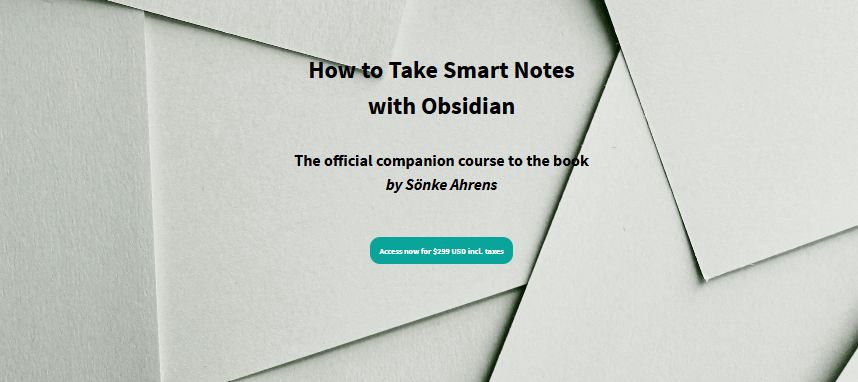

Sönke Ahrens – How to Take Smart Notes Video Course Review: Is It Worth It?
In an age dominated by information overload, traditional note-taking methods often fail us. We highlight passages, save endless bookmarks, and type isolated summaries into digital apps, only to forget them when it comes time to write an article, research paper, or book.
Sönke Ahrens revolutionized modern personal knowledge management (PKM) with his bestseller How to Take Smart Notes, introducing the world to Niklas Luhmann’s famous Zettelkasten system. Following the global success of his book, Ahrens translated his principles into a comprehensive, practical video program: the Sönke Ahrens – How to Take Smart Notes Video Course.
This detailed, honest review examines what the course covers, how it builds upon the book, its core framework, key benefits, and whether it provides the solution you need to transform your research, learning, and content creation workflows.
What Is the How to Take Smart Notes Video Course?
The Sönke Ahrens – How to Take Smart Notes Video Course is a structured, visual learning system designed to help knowledge workers, academics, content creators, and lifelong learners build a reliable second brain.
While the original book explains the theoretical philosophy behind smart note-taking, the video course bridges the gap between understanding the concept and physically setting up a functioning workflow. It focuses on converting passive reading into active learning and turning isolated notes into an interconnected web of original ideas.
Who Is Sönke Ahrens?
Sönke Ahrens is a writer, researcher, and professor of education and philosophy. His work focuses on cognition, educational systems, and learning workflows. Ahrens became a leading figure in productivity circles by analyzing how sociologists like Niklas Luhmann managed to publish dozens of influential books and hundreds of articles using a simple, paper-based slip-box method (Zettelkasten). Ahrens modernized this framework for today’s digital landscape.
The Core Philosophy Behind Smart Note-Taking
To appreciate the value of this video course, it helps to understand the underlying principles Ahrens teaches. Traditional note-taking focuses on storage—saving information by topic, book title, or folder name. Smart note-taking, by contrast, focuses on retrieval and connection.
[ Fleeting Notes / Literature Notes ]
                 │
                 ▼
     [ Permanent Atomic Notes ]
                 │
                 ▼
[ Interconnected Knowledge Network (Zettelkasten) ]
                 │
                 ▼
[ Effortless Writing & Content Production ]
1. The Death of the Blank Page
The primary premise of the course is that writing should never start from scratch. When you sit down to write an essay, report, or post with a blank document, you experience friction and cognitive block. A properly maintained slip-box ensures that when you begin a project, 80% of the research, outline, and original thinking are already done.
2. Bottom-Up Strategy vs. Top-Down Planning
Most people plan top-down: they choose a topic, search for sources, read, and write. Ahrens advocates for a bottom-up approach. You collect interesting ideas, connect them over time, and allow topics and arguments to emerge naturally from your pool of connected thoughts.
3. Focus on Atomic Ideas
Instead of saving lengthy summaries of chapters, smart notes capture a single idea in your own words. These “atomic notes” are easier to link, reorganize, and reuse across multiple future projects.
Inside the Course: Curriculum Breakdown
The course is organized logically to take you step-by-step from foundational setup to advanced knowledge generation. Below is an overview of what you will find inside the video modules.
Module 1: Rethinking How We Learn and Read
-
Active Reading Strategies: Moving away from passive highlighting toward critical engagement with texts.
-
Overcoming the Collector’s Fallacy: Why saving articles and bookmarking pages creates a false sense of accomplishment without real retention.
-
The Cognitive Load: How offloading memories to an external system frees up mental bandwidth for creative problem-solving.
Module 2: The Three Types of Notes
Ahrens clearly defines the workflow mechanics by categorizing notes into three distinct stages:
-
Fleeting Notes: Quick, temporary thoughts caught throughout the day that are processed or discarded within 24–48 hours.
-
Literature Notes: Short, selective summaries of content you read or listen to, written entirely in your own words alongside bibliographic references.
-
Permanent Notes: Highly refined, autonomous notes containing one clear idea, written as if intended for publication, and linked to existing notes in your slip-box.
Module 3: Building and Organizing Your Slip-Box
-
Structuring the Network: Moving away from rigid hierarchical folders in favor of dynamic index tags and bidirectional links.
-
Linking Mechanics: How to create meaningful connections between old and new notes without losing track of context.
-
Project Notes: Keeping project-specific research separate from your main long-term knowledge repository.
Module 4: From Notes to Finished Work
-
Extracting Clusters: Identifying themes and arguments that naturally form inside your database.
-
Translating Notes into Outlines: Assembling permanent notes into a coherent narrative structure.
-
Drafting and Polishing: Transforming connected thoughts into publication-ready prose without writer’s block.
How the Video Course Compares to the Book
Many readers wonder if the video course is necessary if they have already read the book How to Take Smart Notes. Here is how the two formats compare:
While the book provides the theoretical backbone, the video course focuses heavily on execution. Seeing Ahrens demonstrate how notes move through the pipeline makes the system significantly easier to implement without second-guessing yourself.
Key Benefits of Implementing This System
Investing time in this video course yields long-term cognitive and practical returns:
-
Sustained Productivity: Eliminates the mental fatigue associated with starting new writing or research projects.
-
Enhanced Retention: Writing notes in your own words forces deep processing, dramatically improving memory retention.
-
Tool-Agnostic Approach: The principles taught by Ahrens apply whether you use paper index cards, Obsidian, Roam Research, Notion, Logseq, or Evernote.
-
Compound Knowledge: Your slip-box grows more valuable over time. Unlike static folder systems where old notes go to die, a Zettelkasten resurfaces old ideas in new contexts.
-
Clear Thinking: Forcing thoughts into clear, concise atomic sentences highlights gaps in your logic and sharpens your analytical skills.
Practical Tool Integration: Software Compatibility
A common point of confusion for students of Ahrens’ methodology is selecting the right software. The video course emphasizes that the system matters more than the software. However, it adapts seamlessly to modern Personal Knowledge Management (PKM) applications:
-
Obsidian: Ideal for markdown-based, local text files with powerful graph view visualization and bidirectional linking.
-
Roam Research / Logseq: Outliner-based tools perfect for dynamic, block-level referencing and seamless daily notes.
-
Notion: Works well for users who prefer database structures and visual board layouts, provided they implement relational properties.
-
Analog (Paper Cards): For purists who prefer Luhmann’s original physical box setup with physical cards and manual numbering.
Pros and Cons
Pros
-
Direct Instruction: Taught directly by the author who popularized the modern Zettelkasten movement.
-
Clarity: Simplifies complex cognitive theories into visual, easy-to-digest video lessons.
-
Action-Oriented: Eliminates overthinking by providing clear rules for processing fleeting and literature notes.
-
Long-Term Utility: Teaches a methodology that remains relevant regardless of future software trends.
Cons
-
Requires Discipline: The system demands consistent daily effort to turn literature notes into permanent notes.
-
Steep Initial Learning Curve: Transitioning away from traditional folder structures requires a mindset shift that takes time to feel natural.
Final Verdict: Is It Worth It?
The Sönke Ahrens – How to Take Smart Notes Video Course is one of the most effective resources available for anyone looking to organize their intellectual life. It solves the universal problem of forgetting what you read and eliminates the friction of starting new writing tasks.
If you struggle with information overload, feel overwhelmed when starting new projects, or want to build a lifelong knowledge bank that works alongside your brain, this course provides the exact roadmap you need. Ahrens delivers an actionable, well-structured framework that transforms passive information consumption into creative output.
Frequently Asked Questions
Do I need to read the book before taking the video course?
No. The video course covers all essential theories from the book while providing additional visual context and practical walkthroughs. However, reading the book alongside the course can deepen your understanding.
What software do I need to complete the course?
You do not need any specific software. The course principles are universal and work with free tools like Obsidian and Logseq, paid apps like Roam Research, or even traditional pen and index cards.
How long does it take to see results from this system?
You will notice immediate benefits in your reading comprehension and note quality within the first week. The true power of the interconnected network (Zettelkasten) usually becomes obvious after accumulating 50 to 100 permanent notes.
Be the first to review “Sönke Ahrens – How to Take Smart Notes Video Course”
Related products




Uncategorized
Uncategorized
Reviews
There are no reviews yet.