

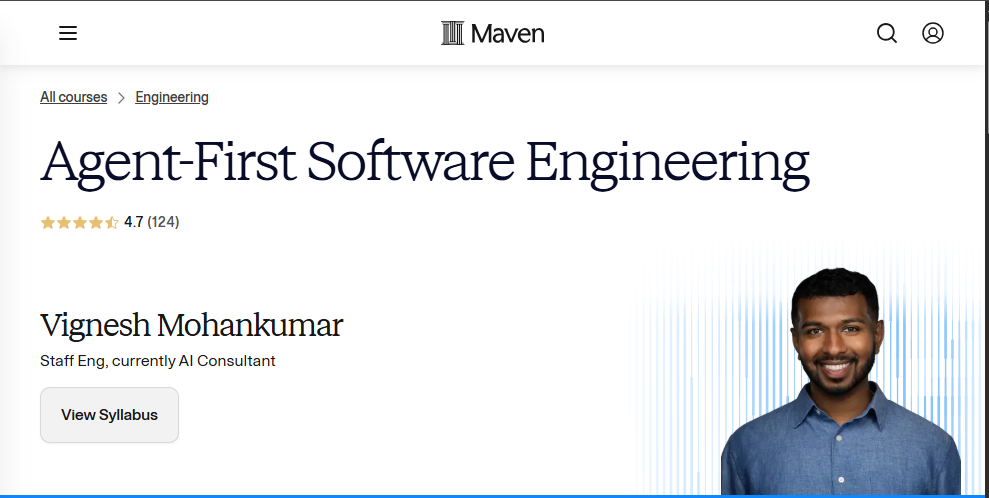

Vignesh Mohankumar – Agent-First Software Engineering: The Ultimate Developer Workflow Review
The landscape of software development is shifting dramatically. For years, writing code meant typing every line manually, navigating deep legacy documentation, and spending hours debugging minor syntax errors. Today, artificial intelligence has entered the chat. However, most developers are caught in a cycle of “vibe coding”—relying on random prompts, copying and pasting unverified snippets, and dealing with oversized pull request diffs that break production environments.
If you are tired of superficial AI hype and want a repeatable, professional system for writing code with artificial intelligence, Vignesh Mohankumar – Agent-First Software Engineering offers a refreshing alternative. Designed as a high-impact accelerator for experienced developers, staff engineers, and technical leads, this program focuses on how senior engineers actually integrate AI into production environments.
In this exhaustive review, we will break down everything you need to know about Vignesh Mohankumar – Agent-First Software Engineering, covering its core curriculum, the Explore → Plan → Build framework, synchronous versus asynchronous workflows, pros and cons, and whether it is worth your investment.
Who is Vignesh Mohankumar?
Before diving into the curriculum, it is essential to understand the practitioner behind the framework. Vignesh Mohankumar is an independent consultant specializing in Applied AI. His core professional focus is helping engineering teams ship features to production within days rather than weeks.
Previously, Vignesh served as a founding engineer at Drift (which was acquired for $1.2 billion) and later led growth engineering teams as a staff engineer. Having built software at scale in fast-paced startup environments, his perspective is rooted in real-world constraints—such as security, code maintainability, team alignment, and production reliability. This background ensures that Vignesh Mohankumar – Agent-First Software Engineering is not a theoretical computer science seminar, but a pragmatic operational playbook built by someone who writes and reviews production code daily.
What is Agent-First Software Engineering?
Many developers treat AI coding assistants like glorified autocomplete tools. They type a quick prompt, hit tab, accept a massive block of generated code, and hope for the best. This approach usually leads to technical debt, subtle security flaws, and painful code reviews.
Vignesh Mohankumar – Agent-First Software Engineering flips this paradigm on its head. Instead of treating AI as a replacement for human thought, the course treats AI as a powerful, tireless junior developer or research assistant that requires structured human oversight.
The core philosophy of the program rests on three main pillars:
-
Human Accountability: Humans remain completely responsible for architecture, correctness, and system outcomes.
-
Systematic Control: Moving away from ad-hoc prompting toward structured, repeatable workflows.
-
Production Safety: Prioritizing smaller, reviewable diffs and rigorous code verification over raw speed and reckless generation.
Core Curriculum Breakdown: What You Will Learn
The curriculum inside Vignesh Mohankumar – Agent-First Software Engineering is divided into actionable modules that address the daily bottlenecks developers face. Here is a detailed breakdown of what is covered:
1. The Explore → Plan → Build Framework
The cornerstone of the accelerator is a structured methodology designed to turn vague product requirements into low-risk, reviewable implementation plans:
-
Explore: Using AI to interrogate unfamiliar codebases, analyze complex dependencies, and map system architecture without falling into hallucination traps.
-
Plan: Structuring design documents, breaking down tasks, and aligning on technical scope before writing a single line of code.
-
Build: Executing incremental code generation with precise context management to ensure clean, correct outputs.
2. Synchronous vs. Asynchronous AI Workflows
Most developers only understand synchronous coding—sitting side-by-side with an AI assistant like Cursor or Copilot. Vignesh Mohankumar – Agent-First Software Engineering expands your toolkit by teaching both styles:
-
Synchronous Workflows: Live coding with AI, managing state and context windows effectively, and extracting clean, correct code from models without messy side effects.
-
Asynchronous Workflows: Setting up background jobs, automated research agents, multi-step refactoring processes, and Slack triggers that run while you focus on high-level architecture.
3. Navigating Large Codebases and Eliminating Hallucinations
One of the biggest hurdles when joining a new project or working with a massive repository is understanding how everything fits together. The course demonstrates how senior engineers use AI to explore codebases safely:
-
Interrogating complex systems without getting lost in model hallucinations.
-
Replacing days of trial-and-error exploration with targeted, AI-driven codebase audits.
-
Pinpointing exact modules, APIs, and data flows in seconds.
4. Advanced Tooling: Sub-Agents, Custom Commands, and Rules
Moving beyond basic chat interfaces, the curriculum dives deep into modern developer tooling (such as advanced Cursor setups, custom system prompts, rules files, and specialized sub-agents). You learn how to configure your environment so that AI tools automatically adhere to your team’s coding standards, linting rules, and architectural patterns.
5. Code Review Discipline and PR Quality
Writing code faster is useless if it takes twice as long to review. Vignesh Mohankumar – Agent-First Software Engineering places heavy emphasis on maintaining high pull request (PR) standards:
-
Keeping diffs small, focused, and easy to reason about.
-
Developing stricter review habits for AI-generated code than for human-written code.
-
Generating design docs from meeting notes and maintaining seamless documentation practices.
6. Team Adoption and Standardization
For engineering managers and technical leads, the course provides frameworks for scaling AI adoption across entire teams:
-
Establishing common team vocabularies for planning and ownership.
-
Preventing tool-driven chaos and avoiding superficial hype cycles.
-
Creating shared standards that align developers, managers, and stakeholders.
Who is Vignesh Mohankumar – Agent-First Software Engineering For?
This accelerator is intentionally specialized. It is not a beginner programming course that teaches you how to write loops or basic syntax. You will get the most value out of Vignesh Mohankumar – Agent-First Software Engineering if you fit one of the following profiles:
-
Experienced Software Engineers: Developers who already know how to build and maintain production software and want to multiply their output without sacrificing code quality.
-
Staff and Senior Engineers: Technical leaders looking for structured methodologies to handle complex system architecture and large codebases using modern AI tools.
-
Engineering Managers and Tech Leads: Leaders responsible for guiding team-wide AI adoption who need practical standards and predictable workflows rather than hype.
-
Engineers Tired of Vibe Coding: Professionals who want rigorous, repeatable engineering frameworks instead of random social-media prompting tricks.
Pros and Cons of the Program
The Pros
-
Practitioner-Led: Taught by a seasoned startup founding engineer and staff engineer who uses these exact workflows in real client consulting daily.
-
Focus on Production Safety: Stresses rigorous review habits, small diffs, and risk mitigation rather than reckless, unverified code generation.
-
Comprehensive Scope: Covers both synchronous live-coding assistants and asynchronous background agent workflows.
-
Actionable Frameworks: The Explore → Plan → Build methodology gives you an immediate mental model you can apply to any tech stack or codebase.
-
Team-Oriented Insights: Addresses organizational adoption, helping leads establish team-wide standards and shared guardrails.
The Cons
-
Prerequisite Experience Required: Absolute beginners or junior developers who are still learning fundamental software engineering concepts may find the pace and expectations challenging.
-
Fast-Moving Tech Ecosystem: Because AI tools evolve rapidly, continuous adaptation is required, though the underlying foundational workflows taught in the course remain timeless.
Final Verdict: Is Vignesh Mohankumar – Agent-First Software Engineering Worth It?
If you view AI coding tools as toys or simple autocomplete extensions, your development velocity will plateau quickly. To truly unlock 10x productivity without introducing massive technical debt or security vulnerabilities, you need a disciplined engineering framework.
Vignesh Mohankumar – Agent-First Software Engineering bridges the gap between raw AI capability and professional software engineering rigor. By emphasizing strict planning, incremental code generation, asynchronous delegation, and rigorous review habits, it provides a masterclass in modern, responsible AI-assisted development.
For senior engineers, tech leads, and teams looking to cut through the social media noise and adopt battle-tested AI workflows, this program is an exceptional investment that pays for itself within your very first sprint.
Be the first to review “Vignesh Mohankumar – Agent-First Software Engineering”
Related products



Uncategorized

Uncategorized

Uncategorized

Uncategorized

Uncategorized
Reviews
There are no reviews yet.